Friday, 25 September 2015

Invisible Cities: Thumbnails 13-22


First time sketching thumbnails from Photoshop [Adobe] and Wacom drawing tablet. Want to manage time properly so carefully balancing between brush experimenting and thumbnail drawing - exciting to discover variations in size, tone and water for different brushes:

Diomira [13-14] - At first glance of description, personally visualising "theatre land" [e.g. facade to Royal Opera House, London] surrounded by narrow terraced buildings, sight towers, bird statues and market stalls. Really liked outcome of pens and brushes I was using and how much pressure and quantity I was using - quite French Impressionist outcome, which could be seen as perfect for concept art drawing. Outcome also reminded me of other locations and ideas - Venice street buildings, Hollywood studio backlot buildings, and regenerated waterfronts (e.g. Lisbon Expo Park).


Links - Venice street, Warner Bros. Backlot [Los Angeles], Lisbon Expo Park [1998], Royal Opera House [London]

Ersilia [15-17] - Excited to develop concept which, at first glance, quickly resembling houses and villages found in countries like Nepal - rocky rubble, derelict housing, rising mountains in background, bright poles for supporting ropes and strings, even drawing hanging lanterns or lightbulbs as sign of direction into next location [17]. Experimenting with larger brush sizes with softer touch, creating believable smokey atmosphere inside one of abandoned houses [16].


Links - Himalayas [China/Nepal], Nepal town, hanging lanterns

Esmerelda [18-20] - Another exciting concept to explore, and was aiming to draw out dynamic angles featuring canal intersection, and interaction with surrounding buildings at varying heights, plus featuring city's cats about to jump off to different roofs. By No. 20, really wanted to stop drawing lines to realise shapes, as that's not what concept art should be about, so experimenting with particular brush that turned out to have 'snowy' effect, and simply drawing quick strokes to suggest direction of canals. Outcomes later reminding me of real-life locations - e.g. Venice canals [suggestion that Calvino is referring to Venice in many of his woman-named cities] and loading bays to log flume rides [e.g. Splash Mountain, Magic Kingdom, Florida]


Links - Venice canal, Splash Mountain loading bay [Magic Kingdom, Florida]

Fedora [21-22] - Not exactly city description but instead fascination with abandoned concepts and missed opportunities. Going more energetic with chalk-like brushstrokes to draw projected castle-like cities in clean glass globes sitting on columns [e.g. Enchanted Rose in Beauty & the Beast], but contrasting with seeping dark smoke and rubble [larger, softer strokes]. No. 22 reveals surrounding atmosphere in brightly coloured exhibition room, with hole outside revealing entire rubble city, as if destroyed by bomb attack.


Links - Concept Art, Beauty & the Beast [1991, Walt Disney], Aleppo [Syria]

Thursday, 24 September 2015

Invisible Cities: Thumbnails 7-12


Recently took advice from tutor: not to take pencil sketches already as clear and detailed final designs, but concept art which can be finalised later in process. In addition, to be more energetic with sketching to get down ideas in a quick and excited way, and not to take Calvino's texts literally but adapt from his loosely detailed descriptions of the cities:

Armilla [7-8] - Ongoing exploration of "forest of pipes", his description reminding me of public art work in Turbine Hall of Tate Modern: Carsten Holler's Tube Slides, creating new village of pipes from different platforms (perhaps I can evolve from that idea). Gradually realising need to improve on perspective awareness and not make original concept seem flat and two-dimensional like it's set design for platform video game.

Baucis [9-10] - Exploring exciting concept of raised town above wilderness forest, although essentially would sound something like simply rainforest canopy, really wanted to exaggerate proportions and play with interaction between rising stilts and forest below - lampposts, cyclists, birdhouses, etc.

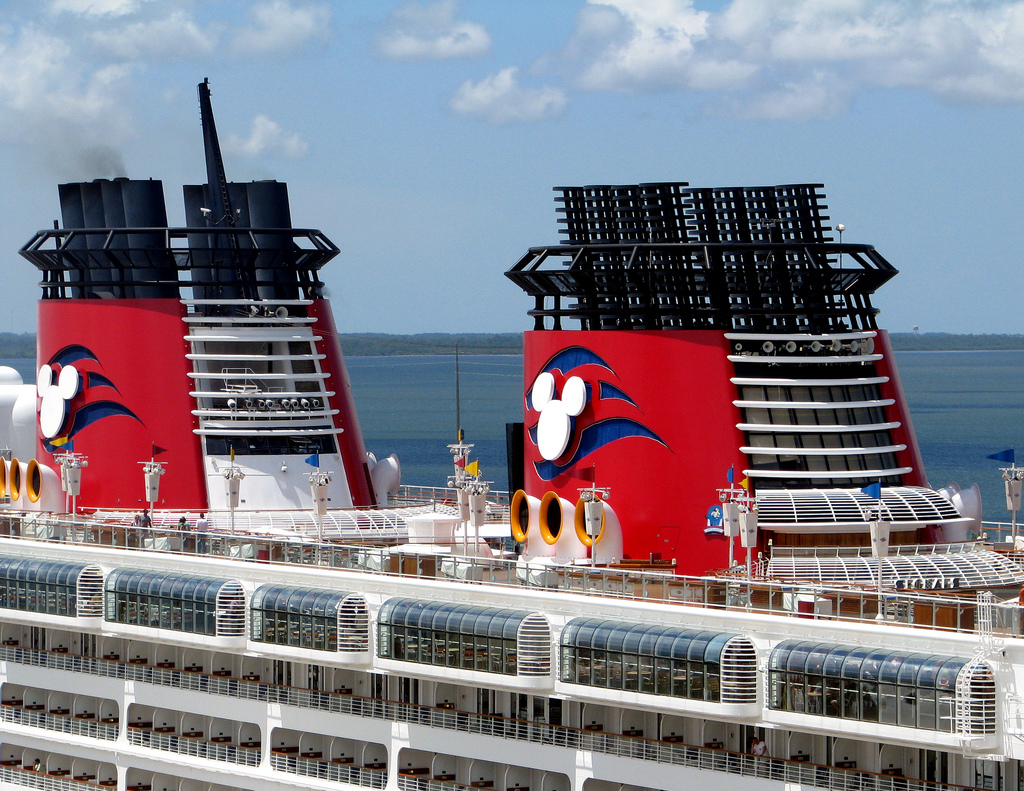
Despina [11-12] - Really excited in sketching, to my perspective, cruise-ship inspired harbour city, as passenger and his camel are amazed by structures popping up high all around them - ship components such as funnels, waving flags and wooden boardwalks. Inspiration from Cardiff waterfront [collection of varying shapes and colours from different time periods], as well as Disney Cruise Line - intertwining traditional ship structure with colourful recreation facilities [huge contrast between multicolour and plain seawater].


Links - Carsten Holler's Test Site [2006, Tate Modern, London], rainforest canopy bridge, Disney Cruise Line [Fleet: 1998-2012]

Wednesday, 23 September 2015

Space Oddities: The Cabinet of Dr. Caligari (1920)

 
Robert Wiene’s The Cabinet of Dr. Caligari (1920), whilst essentially seen as a silent horror film made in the inter-war years, can be called a piece of artwork from the German Expressionist movement, which quickly rose from the country’s defeat in World War I. The film’s outrageous and horrific production design seems to stand out the most, featuring jagged shapes, leaning buildings, distorted perspective and thick divisions between light and dark, as if the production designers took the black-and-white filmstrip to its greatest advantage (see Fig. 1).
 
Fig. 1 
 
On first sight, it can be said that silent films as a whole, in comparison with the later talkies, focussed significantly more on visual literacy, especially with production design; some may even argue that the invention of sound destroyed beautiful visual storytelling. Both writer Carol King and film school tutor Dominic Power put forward that “motion pictures both created and fed an appetite for spectacle, offering the possibility of recreating the past, reimagining the present and visualising the future (Kemp, 2011:19), whilst film director Martin Scorsese recites director King Vidor’s words that the cinema “is an illusion, more powerful than any other [medium] (A Personal Journey with Martin Scorsese Through American Movies, Pt. 2, 1995)”.
 
When making comparisons with George Melies’ A Trip to the Moon (1902), focusing on ideas popular during the turn of the new century such as decorated ornamentation, Imperialism, progressivism and the voyage of discovery, Caligari immediately explores the impacts of the Great War, replacing optimism with social uncertainty, moral doubt and growing paranoia, reflected into the film’s stripped back and juxtaposed production design. “[Caligari] created a world where the futuristic sets became actors – they visually created a realm so terrifying that audiences felt its dark and looming presence long after the film was over. (Whitlock, 2010:53)”. This could therefore argue that not all filmmaking should be made purely for fantasy or escapism, but to challenge the public’s perception and force them to ask questions.
 Melies' A Trip to the Moon (1902) [Fig. 2]
Wiene's The Cabinet of Dr. Caligari (1920) [Fig. 3]
 
Art historian Stephen Little defines Expressionism as “the art of unrest and the search for truth (Little, 2004:104), and that the movement is “characterised by emotional extremes which can be traced back to the works of [Vincent] Van Gogh [and] Edvard Munch (Little, 2004:104).” Expressionist painters such as Max Beckmann, Wassily Kandinsky and Ernst Ludwig Kirchner “used strong colour, distorted figures, and sometimes abstraction to explore themes of belonging and alienation (Little, 2004:104). Indeed, the story of Caligari greatly focuses on themes such as paranoia, questioning one’s identity and fear of death, for example, the sleepwalker’s prophecy of a strictly limited life. The film’s twist ending could perhaps extend these themes even further, showcasing a somewhat ‘circle of life’ as the character is revealed to be the (next) sleepwalker.

 Kandinsky's Improvisation 28 (second version) (1912, oil on canvas) [Fig. 4]
Kirchner's Artillerymen (1915, oil on canvas) [Fig. 5]
 
It can be highlighted that Caligari’s cinematography resembles little different than to simply ‘theatre-on-screen’, as if the viewer would be standing in front of these characters, though it could be argued that this was a result of technological limitations of the time. Critic Kim Newman states that “the film relies entirely on theatrical devices, the camera fixed centre stage as the sets are displayed and the actors providing any movement or impact (Schneider, 2011:31), which could probably explain the bright and exaggerated costume and makeup (see Fig. 6). A film like Caligari could therefore contribute to the argument ‘Why make a film in an environment you can easily recreate on stage?’
 
Fig. 6 
 
Journalist Cathy Whitlock puts forward the long-term impacts of Caligari beyond the culture of Weimar Germany, such as the growth of horror and film noir in Hollywood in the 1930s-40s (e.g., James Whale’s Frankenstein (1931)), and the impact on today’s filmmakers such as Tim Burton (e.g. Edward Scissorhands (1990)): “Filmmakers and art directors would turn to German Expressionism throughout the century to convey some of the most frightening, dark and shadowy moments seen on film (Whitlock, 2010:55).
 
In conclusion, Caligari could be seen as one of the few instances where film fully embraces the radical art movements that impact on general society at that time, especially true when observing film industries outside of America, like Germany’s, who would have wanted to take different directions than to Hollywood’s money-making interests: “The twenties… marked the birth of the [Hollywood] studio system as an “entertainment factory” – films were literally manufactured as products on an assembly line (Whitlock, 2010:41)”.
 
Bibliography:

Books:
  • KEMP, P. (general editor) (2011) Cinema: The Whole Story. London: Thames & Hudson
  • LITTLE, S. (2004) Isms: Understanding Art. London: Herbert Press
  • PARKINSON, D. (2012) 100 Ideas That Changed Film. London: Laurence King
  • SCHNEIDER, S. (general editor) (2011) 1001 Movies You Must See Before You Die. London: Octopus
  • WHITLOCK, C. (2010) Designs on Film: A Century of Hollywood Art Direction. New York: Harper-Collins
Television:
Illustration List:
  • A Trip to the Moon (1902) From: A Trip to the Moon. Directed by Melies, G. [Film still] France: Star Film. At: http://www.hitfix.com/blogs/in-contention/posts/martin-scorseses-hugo-and-technicolor-restore-the-magic-of-m-li-s (Accessed 23/9)
  • The Cabinet of Dr. Caligari (1920) From: The Cabinet of Dr. Caligari. Directed by: Wiene, R. [Film still] Germany: Babelsberg. At: http://bloody-disgusting.com/news/3156247/horror-education-of-the-week-the-cabinet-of-dr-caligari/ (Accessed 23/9)
  • The Cabinet of Dr. Caligari (1920) From: The Cabinet of Dr. Caligari. Directed by: Wiene, R. [Film still] Germany: Babelsberg. At: https://drafthouse.com/movies/the-cabinet-of-dr.-caligari/san_antonio (Accessed 23/9)
  • The Cabinet of Dr. Caligari (1920) [Poster] At: http://www.openculture.com/2013/10/the-cabinet-of-dr-caligari-see-the-restored-version.html (Accessed 23/9)
  • The Cabinet of Dr. Caligari (1920) From: The Cabinet of Dr. Caligari. Directed by: Wiene, R. [Film still] Germany: Babelsberg. At: http://www.theguardian.com/film/2010/oct/22/cabinet-caligari-wiene-horror (Accessed 23/9)
  • Kandinsky, W. (1912) Improvisation 28 (second version) At: http://www.guggenheim.org/new-york/collections/collection-online/artwork/1861 (Accessed 23/9)
  • Kirchner, E. (1915) Artillerymen [Oil on canvas] At: http://www.guggenheim.org/new-york/collections/collection-online/artwork/2104 (Accessed 23/9)

Tuesday, 22 September 2015

Profiles - Adobe Photoshop & Wacom

Adobe Photoshop [CC 2015]:

Developer – Adobe, San Jose
Initial release – 1990
Operating systems – Windows, Mac OS X
Type – Raster graphics editor
License – Shareware and software as a service
Website – www.adobe.com/photoshop

Adobe Photoshop is a raster graphics editor developed and published by Adobe for Windows and OS X. The software has become the de facto industry standard in raster graphics editing, such that the word "photoshop" has become a verb as in "to photoshop an image," "photoshopping," and "photoshop contest," etc. It can edit and compose raster images in multiple layers and supports masks, alpha compositing and several colour models including RGB, CMYK, Lab colour space, spot colour and duotone. Photoshop has vast support for graphic file formats but also uses its own PSD and PSB file formats which support all the above-mentioned features. In addition to raster graphics, it has limited abilities to edit or render text, vector graphics (especially through clipping path), 3D graphics and video.

Adobe Systems:

Spanish – “Mud brick”
Industry – Computer software
Headquarters – San Jose, California
Stock exchange – NASDAQ, New York
Founders – John Warnock & Charles Geschke
Website – www.adobe.com

Adobe Systems is an American multinational computer software company. Adobe has historically focused upon the creation of multimedia and creativity software products, with a more-recent foray towards rich Internet application software development. It is best known for Photoshop, the Portable Document Format (PDF) and Adobe Creative Suite, as well as its successor Adobe Creative Cloud.
Adobe was founded in 1982 by Warnock and Geschke, who founded the company after leaving Xerox PARC in order to develop and sell the PostScript page description language. In 1985, Apple Computer licensed PostScript for use in its LaserWriter printers, which helped spark the desktop publishing revolution.

Wacom:
Japanese – “Harmony circle”
Industry – Computer input devices and software
Stock exchange – Tokyo
Founded – 1983
Headquarters – Tokyo, Japan
Website – www.wacom.com
Wacom is a Japanese company that specializes in graphics tablets and related products. Wacom tablets are notable for their use of a patented cordless, battery-free, and pressure-sensitive stylus or digital pen. In addition to manufacturing and selling tablets, Wacom also provides graphical input technology for some tablet computers, which it calls "Penabled Technology".


Perspective Drawing Exercises

 
Took quite some time to discover how to construct 3D shapes with angles properly - constructing certain faces with viewpoints themselves. Received help from Thomas Smith's blog (www.peachflandango.blogspot.co.uk) on perspective drawings.

Sunday, 20 September 2015

Invisible Cities: Thumbnails 1-6


Sketching quick thumbnails to adapt Calvino's Invisible Cities [1972] onto sketchbook pages:

Anastasia [1-3] - I thought main idea behind description was expressing and exaggerating beauty, but reminding the visitor where his place is in this land - "you believe you are enjoying Anastasia wholly when you are only its slave." Reminding me of artists and concepts such as Hundertwasser, Berlin's Potsdamer Platz, Cardiff's redeveloped waterfront, Canary Wharf, Heathrow Airport and other architecture places primarily to serve businesspeople (not to mention Don Bluth's Anastasia) - so became interested in conflicting business with pleasure, exaggerated entertainment (stadium screens, swimming pools, clock tower decorations, etc.), colliding with small boarded airport walkways (currency signs) - "You are nothing!"

Argia [4-5] - Exploring concept of piling up dirt-debris entirely throughout city. Covering windows and doors, overgrowing grass and plants, tight chutes that people try to walk/squeeze through. Debris pile so massive that some have to slide down dug chutes (surrounded by seagulls) to get to city centre

Armilla [6] - Exploring idea of entire structures supported by just pipes (various sizes and directions) - in a way, designed to look slightly dangerous to run at fast pace (fear of falling from large pipes with no handle support)


Links - Hundertwasser, Sony Center [Potsdamer Platz, Berlin], Canary Wharf [Tower Hamlets, London], Mermaid Quay [Cardiff waterfront], seagulls at the dump, pipes screensaver

Tuesday, 8 September 2015

CAA Summer Project 2015: Aardvark-Snake

Aardvark-Snake - Original thumbnail sketch

Aardvark-Snake - Side


Aardvark-Snake - Front
Aardvark-Snake - Side
Aardvark-Snake - Back


Aardvark-Snake - Concept Art


Google Image Search - "Snake" and "Aardvark"

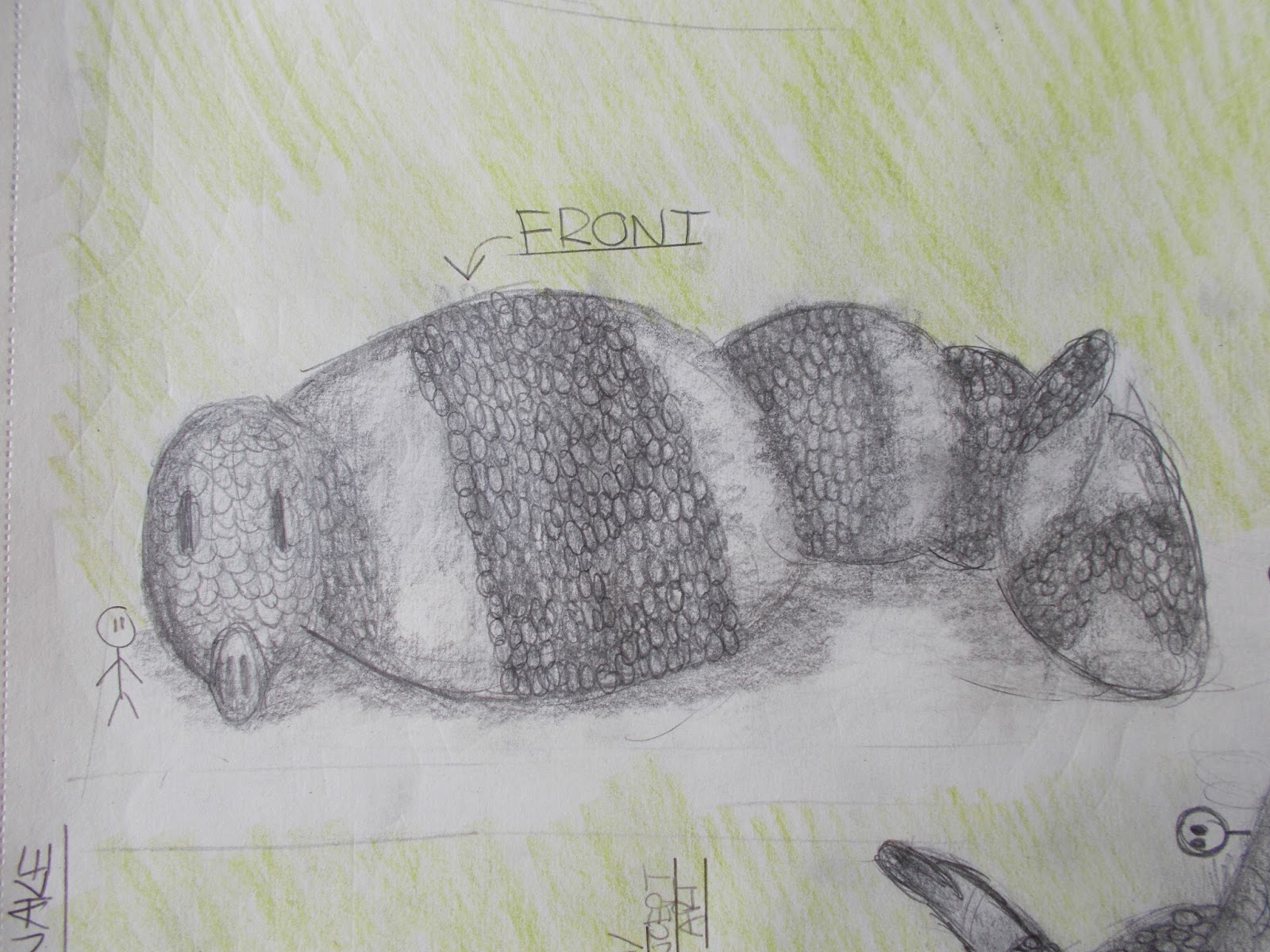
I chose the Aardvark-Snake because of the interesting cramped-like posture that I modelled from the silhouette of the stiletto - the stiletto's heel also suggested the shape of the snout. I was also eager to develop from the creature's slimy and scaly textures, and I really wanted to challenge myself in being able to recreate this posture in all four angles. Indeed, I had some difficulty forming the creature's posture seen at different angles, so I used modelling clay to fashion a model of the posture to be viewed in all angles.
The interesting floor plan of the creature and the design of the snout inspired me to draw concept art reflecting my detailed turnaround. Overall, I am really happy with the final of all three turnarounds.