Showing posts with label Film Reviews. Show all posts

Sunday, 11 October 2015

Space Oddities: Metropolis (1927)

 
Fig. 1, Metropolis (1927), Poster
 
Fritz Lang’s Metropolis [1927] can be often given the honour as “the first science-fiction epic (Newman, 2011:56)”, largely driven by its production design: “The set’s gleaming metallic towers created a city of 2025 and set the standard for sci-fi films and futuristic fantasies (Whitlock, 2011:55)”. However, just like Robert Wiene’s The Cabinet of Dr. Caligari [1920] should be viewed deeper than just a plain horror film, it can be argued that the Metropolis story of ‘man vs. machine’ contains deeper elements than just plain sci-fi spectacle, especially when looking into context of Weimar Germany and the 1920s economic boom – the film premiered just two years before the Wall Street Crash of 1929, ultimately ending the Roaring Twenties.
 
 
Fig. 2, Metropolis (1927)
 
The great epic can be said to have dominated much of silent cinema since its earliest years, driven by the new technology and creative opportunities, as “directors looked back at their country’s classical past to make films that were visually extravagant and operatic in scale (King, 2011:26)”, as seen in films such as D.W. Griffith’s Intolerance [1916] [Crucifixion of Jesus, Ancient Babylon, 16th-century France and modern-day America] (Wikipedia, 2015), and Cecil DeMille’s The Ten Commandments [1923]. Metropolis, however, can be said to depict worrying visions of the future, rather than reflecting historical events. There are certain moments seen in the film’s production design that could be designed to resurrect issues from the past, such as the modern-day Babylon Tower, and the worker’s tower resembling one of the ancient Egyptian pyramids where slaves are about to be taken in. 
 
 
Fig. 3, Metropolis (1927)
 
Compared with the great epics of earlier years containing highly decorative, historical and naturalistic sets, Lang “favoured restrained modern designs with cubistic architecture and geometric grid patterns (Whitlock: 2011:55)”, and looked to the architecture of the rapidly rising New York as his inspiration. Whitlock’s analyses the wide gap between classes; that Metropolis’ “futuristic city set painted a future where bureaucrats sat in their skyscrapers and towered over a world of underground workers below (Whitlock: 2011:55)”; that the planned city epicentre contradicts with the unplanned underground worshipping places set up by the workers [could be compared to settlements today such as Rio de Janeiro’s favelas]. The production design could reflect the trends and attitudes of the time in the booming 1920s, when modernist movements such as Art Deco and Bauhaus seemed to have dominated architecture and interior design in the Western world, and the rise of mass consumerism could have “brought more conflict than celebration (History, 2015)”. Indeed, the film’s later depiction of the gradual tearing down of society by the working people, as well as featuring huge divisions between the underground city’s electrical sparks and floods and the cloud-filled, dreamlike land of the partying aristocracy, could depict warnings of revolutions such as the on-going Russian Revolution and the rise of the Nazi Party.
 
 
Fig. 4, Metropolis (1927)
 
Though Metropolis at first glance could be best remembered for its futuristic city production design, the film takes a huge focus on intertwining human stories in even the smallest of locations, such as in the underground worshipping place, and could suggest the director’s intention of taking the audience on a rollercoaster ride between areas of mountainous terrain and pools of calm: “The audience is interested in individuals, who they can love or hate (A Personal Journey with Martin Scorsese through America Movies, Pt. 2, 1995)”. Indeed, the story involves an aristocrat jumping out of his commonplace environment and decides to swap identities with an underground worker, similar to Mark Twain’s The Prince & the Pauper (Wikipedia, 2015).
 
Additional notes:
  • Mechanisation – rise of humanoid – “Brilliant eroticisation and fetish-isation of modern technology (Bradshaw, 2010)”
  • Gradual tearing down of society – revisiting areas previously mundane now being torn down – whilst class live in luxury like nothing’s happened – “One of the biggest, strangest, maddest films in cinema history (Bradshaw, 2010)”
  • Hallucinating fantasy motion graphics – similar to those in The Cabinet of Dr. Caligari
 
Bibliography:
 
Books:
  • KEMP, P. (editor) (2011) Cinema: The Whole Story. London: Thames & Hudson
  • SCHNEIDER, S. (editor) (2011) 1001 Movies You Must See Before You Die. Octopus: London
  • WHITLOCK, C. (2010) Designs on Film: A Century of Hollywood Art Direction. New York: Harper-Collins
Websites:
Television:
Illustration List:

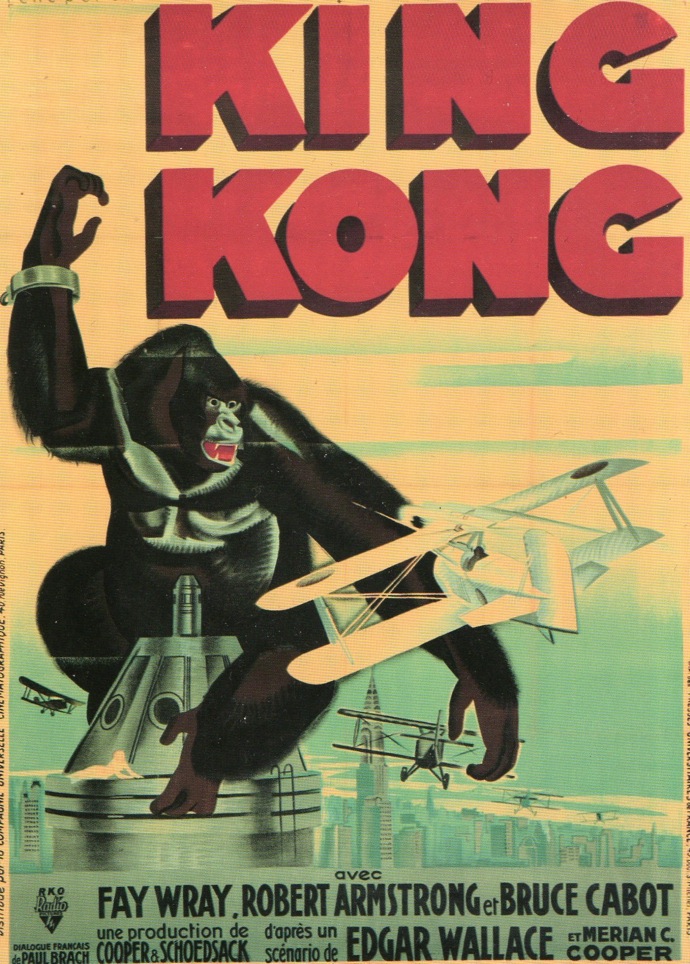
Space Oddities: King Kong (1933)

 
Fig. 1, King Kong (1933), Poster 
 

Whilst Merian Cooper & Ernest Schoedsack’s King Kong [1933] could be defined simply as an action-adventure picture dominated by special effects, it should be viewed within the context of the suggestive golden age of “Gothic Horror” that thrived in pre-Code 1930s Hollywood, alongside other horror films containing significant amounts of violence and sexual content such as Universal’s monster films – James Whale’s Frankenstein (Newman, 2011:92-93), Tod Browning’s Dracula, etc. (Hunter, 2011:88-91) Lecturer Russ Hunter explains that “before the Hays Office’s strict implementation of self-censorship halted experiments in suggestiveness and explicit gore, the early sound era saw gothic horror movies flourish. (Hunter, 2011:89)” This could explain the explosion in use of set design, costume design and special effects even after the end of the silent era, as audiences flocked to the cinemas in the need of fantasy and escapism during the Great Depression of the 1930s. “Audiences were able to check in Berlin’s Grand Hotel [Edmund Goulding], fly down to Rio [Thornton Freeland], and vanish to Lost Horizon’s [Frank Capra] Shangri-La without ever leaving their seats” (Whitlock, 2010:63).


Fig. 2, King Kong (1933)
 
Because of the film’s dominance in special effects, King Kong, “the undisputed champ of all monster movies (Klein, 2011:109)”, could also be hailed as the precursor to the blockbuster age starting in the 1970s, where films such as John Guillermin’s The Towering Inferno [1974], Steven Spielberg’s Jaws [1975] and George Lucas’ Star Wars [1977] (Kemp, 2011:362-67) were known to use “a narrow set of generic parameters – science fiction, horror, comedy, fantasy, disaster or action – to attract the largest possible audience. (Huddleston, 2011:361)” Indeed, King Kong was remade in 1976 by Guillermin (Wikipedia, 2015), in an age when special effects began to rise up to a level at least as high as the story.
 
 
Fig. 3, King Kong (1933)
 
The film can be seen as another interesting fish-out-of-water concept alongside Fritz Lang’s Metropolis, as King Kong is transported from the pre-industrial Skull Island to the 1930s Art Deco of New York, as can be praised for its achievement in layering set design and especially the stop-motion animation of the main character led by special effects artist Willis O’Brien. Looking deeper, however, it also could be argued that the use of stop-motion animation in the film was a crucial step in the development of sophisticated, energetic and detailed movement, when observing 1930s Western animation, often seen as “the period when animation came of age (Beck, 2004:54)” Director Barry Purves argues that “many of the techniques used in purely animated [features] were developed over the years in which the technique was used as a special effect within live-action films, when certain ideas simply couldn’t be achieved any other way (Purves, 2014:36)”.
 
 
Fig. 4, King Kong (1933) 
 

As well as the striking dynamic movement of King Kong by O’Brien, the set design of Skull Island should also be pointed out, consisting of wall paintings, miniatures and other components to help create an illusion of perspective: the jungle scene’s multiple layers in particular are able to give a true sense of depth to the viewer, whilst its main function is to blur the divide between the animation shots and the live-action studio set shots – e.g. King Kong fighting the reptile creature as the woman lies in the foreground.

The concept of multiple layer set design could also help showcase the increasing technology being used in Western animation, rather than just live-action, to help increase the sense of depth and realism, no example clearer of this perhaps than Walt Disney’s The Old Mill [1937], made to experiment with the new multi-plane camera [e.g. rising upwards inside the old windmill] and released shortly before the studio’s first feature Snow White & the Seven Dwarfs [1937]. Disney believed that “in order to sustain an audience’s interest for over an hour, he would need to create a realistic, believable world and characters (Cavalier, 2011:118) in which the short is able to achieve, focusing on realistic-looking animals and the natural world, which could have been seen as a huge departure from the slapstick comedy shorts the studio had been known for years earlier – Steamboat Willie [1928], The Three Little Pigs [1933], etc. Cavalier explains that “The Old Mill marks the defining moment when animation moved into realism, and is possibly one of Disney’s most technically-advanced shorts (Cavalier, 2011:118).


Figs. 5 & 6, The Old Mill (1937) 
 
In summary, King Kong could be seen as a stepping stone in increasing the sophistication and realism not just in big-budget fantasy-adventure films, through its advancing special-effects technology, but for both live-action and especially animation, as the public would become “dazzled by evolving new techniques, more sophisticated storytelling and advanced visuals (Beck: 2004:54)”. Cathy Whitlock points out that “the modern concept of film genre also came into being in the [1930s]. Standard categories helped define and differentiate between particular film styles – from musicals to horror films to screwball comedies (Whitlock, 2010:63)”, which could help explain the explosion in recognisable big-budget fantasy-adventure films during this time.
 
Bibliography:

Books:
  • BECK, J. (editor) (1994) The 50 Greatest Cartoons: As Chosen by 1000 Animation Professionals. Atlanta: Turner
  • BECK, J. (editor) (2004) Animation Art: From Pencil to Pixel, the History of Cartoon, Anime & CGI. London: Flame Tree
  • CAVALIER, S. (2011) The World History of Animation. London: Arum
  • KEMP, P. (editor) (2011) Cinema: The Whole Story. London: Thames & Hudson
  • PURVES, B. (2014) Stop-Motion Animation Frame by Frame Filmmaking with Puppets & Models. London: Bloomsbury
  • SCHNEIDER, S. (editor) (2011) 1001 Movies You Must See Before You Die. London: Octopus
  • WHITLOCK, C. (2010) Designs on Film: A Century of Hollywood Art Direction. New York: Harper-Collins
Websites:
Illustration List:

Wednesday, 23 September 2015

Space Oddities: The Cabinet of Dr. Caligari (1920)

 
Robert Wiene’s The Cabinet of Dr. Caligari (1920), whilst essentially seen as a silent horror film made in the inter-war years, can be called a piece of artwork from the German Expressionist movement, which quickly rose from the country’s defeat in World War I. The film’s outrageous and horrific production design seems to stand out the most, featuring jagged shapes, leaning buildings, distorted perspective and thick divisions between light and dark, as if the production designers took the black-and-white filmstrip to its greatest advantage (see Fig. 1).
 
Fig. 1 
 
On first sight, it can be said that silent films as a whole, in comparison with the later talkies, focussed significantly more on visual literacy, especially with production design; some may even argue that the invention of sound destroyed beautiful visual storytelling. Both writer Carol King and film school tutor Dominic Power put forward that “motion pictures both created and fed an appetite for spectacle, offering the possibility of recreating the past, reimagining the present and visualising the future (Kemp, 2011:19), whilst film director Martin Scorsese recites director King Vidor’s words that the cinema “is an illusion, more powerful than any other [medium] (A Personal Journey with Martin Scorsese Through American Movies, Pt. 2, 1995)”.
 
When making comparisons with George Melies’ A Trip to the Moon (1902), focusing on ideas popular during the turn of the new century such as decorated ornamentation, Imperialism, progressivism and the voyage of discovery, Caligari immediately explores the impacts of the Great War, replacing optimism with social uncertainty, moral doubt and growing paranoia, reflected into the film’s stripped back and juxtaposed production design. “[Caligari] created a world where the futuristic sets became actors – they visually created a realm so terrifying that audiences felt its dark and looming presence long after the film was over. (Whitlock, 2010:53)”. This could therefore argue that not all filmmaking should be made purely for fantasy or escapism, but to challenge the public’s perception and force them to ask questions.
 Melies' A Trip to the Moon (1902) [Fig. 2]
Wiene's The Cabinet of Dr. Caligari (1920) [Fig. 3]
 
Art historian Stephen Little defines Expressionism as “the art of unrest and the search for truth (Little, 2004:104), and that the movement is “characterised by emotional extremes which can be traced back to the works of [Vincent] Van Gogh [and] Edvard Munch (Little, 2004:104).” Expressionist painters such as Max Beckmann, Wassily Kandinsky and Ernst Ludwig Kirchner “used strong colour, distorted figures, and sometimes abstraction to explore themes of belonging and alienation (Little, 2004:104). Indeed, the story of Caligari greatly focuses on themes such as paranoia, questioning one’s identity and fear of death, for example, the sleepwalker’s prophecy of a strictly limited life. The film’s twist ending could perhaps extend these themes even further, showcasing a somewhat ‘circle of life’ as the character is revealed to be the (next) sleepwalker.

 Kandinsky's Improvisation 28 (second version) (1912, oil on canvas) [Fig. 4]
Kirchner's Artillerymen (1915, oil on canvas) [Fig. 5]
 
It can be highlighted that Caligari’s cinematography resembles little different than to simply ‘theatre-on-screen’, as if the viewer would be standing in front of these characters, though it could be argued that this was a result of technological limitations of the time. Critic Kim Newman states that “the film relies entirely on theatrical devices, the camera fixed centre stage as the sets are displayed and the actors providing any movement or impact (Schneider, 2011:31), which could probably explain the bright and exaggerated costume and makeup (see Fig. 6). A film like Caligari could therefore contribute to the argument ‘Why make a film in an environment you can easily recreate on stage?’
 
Fig. 6 
 
Journalist Cathy Whitlock puts forward the long-term impacts of Caligari beyond the culture of Weimar Germany, such as the growth of horror and film noir in Hollywood in the 1930s-40s (e.g., James Whale’s Frankenstein (1931)), and the impact on today’s filmmakers such as Tim Burton (e.g. Edward Scissorhands (1990)): “Filmmakers and art directors would turn to German Expressionism throughout the century to convey some of the most frightening, dark and shadowy moments seen on film (Whitlock, 2010:55).
 
In conclusion, Caligari could be seen as one of the few instances where film fully embraces the radical art movements that impact on general society at that time, especially true when observing film industries outside of America, like Germany’s, who would have wanted to take different directions than to Hollywood’s money-making interests: “The twenties… marked the birth of the [Hollywood] studio system as an “entertainment factory” – films were literally manufactured as products on an assembly line (Whitlock, 2010:41)”.
 
Bibliography:

Books:
  • KEMP, P. (general editor) (2011) Cinema: The Whole Story. London: Thames & Hudson
  • LITTLE, S. (2004) Isms: Understanding Art. London: Herbert Press
  • PARKINSON, D. (2012) 100 Ideas That Changed Film. London: Laurence King
  • SCHNEIDER, S. (general editor) (2011) 1001 Movies You Must See Before You Die. London: Octopus
  • WHITLOCK, C. (2010) Designs on Film: A Century of Hollywood Art Direction. New York: Harper-Collins
Television:
Illustration List:
  • A Trip to the Moon (1902) From: A Trip to the Moon. Directed by Melies, G. [Film still] France: Star Film. At: http://www.hitfix.com/blogs/in-contention/posts/martin-scorseses-hugo-and-technicolor-restore-the-magic-of-m-li-s (Accessed 23/9)
  • The Cabinet of Dr. Caligari (1920) From: The Cabinet of Dr. Caligari. Directed by: Wiene, R. [Film still] Germany: Babelsberg. At: http://bloody-disgusting.com/news/3156247/horror-education-of-the-week-the-cabinet-of-dr-caligari/ (Accessed 23/9)
  • The Cabinet of Dr. Caligari (1920) From: The Cabinet of Dr. Caligari. Directed by: Wiene, R. [Film still] Germany: Babelsberg. At: https://drafthouse.com/movies/the-cabinet-of-dr.-caligari/san_antonio (Accessed 23/9)
  • The Cabinet of Dr. Caligari (1920) [Poster] At: http://www.openculture.com/2013/10/the-cabinet-of-dr-caligari-see-the-restored-version.html (Accessed 23/9)
  • The Cabinet of Dr. Caligari (1920) From: The Cabinet of Dr. Caligari. Directed by: Wiene, R. [Film still] Germany: Babelsberg. At: http://www.theguardian.com/film/2010/oct/22/cabinet-caligari-wiene-horror (Accessed 23/9)
  • Kandinsky, W. (1912) Improvisation 28 (second version) At: http://www.guggenheim.org/new-york/collections/collection-online/artwork/1861 (Accessed 23/9)
  • Kirchner, E. (1915) Artillerymen [Oil on canvas] At: http://www.guggenheim.org/new-york/collections/collection-online/artwork/2104 (Accessed 23/9)